Drive-Thru Headsets: What Actually Separates Analog From Digital
A drive-thru conversation lasts about fifteen seconds. In that window the crew member has to catch the item, the size, the add-ons and any modification, and the customer has to hear the confirmation. When audio quality drops, it doesn't show up in your reports as "bad sound." It shows up as a remade order, a car parked at the window an extra minute, and a queue stacking up behind it.Most operators respond by replacing headsets or turning the volume up. That usually makes things worse — raising the volume raises the noise with it.The real fix starts with one distinction: audio in a drive-thru system passes through two very different stages, and each one degrades the sound in its own way.
The signal path
- Capture — the microphone inside the speaker post at the order point.
- Wireless transmission — from the base station to the headset the crew member wears.
- Processing — what the system does to the signal before it reaches the ear.
Analog and digital differ at stages two and three. This is where the common misunderstanding sits: people assume "digital" means a newer-looking headset, when it actually means a fundamentally different way of carrying sound and handling noise.
How an analog system works
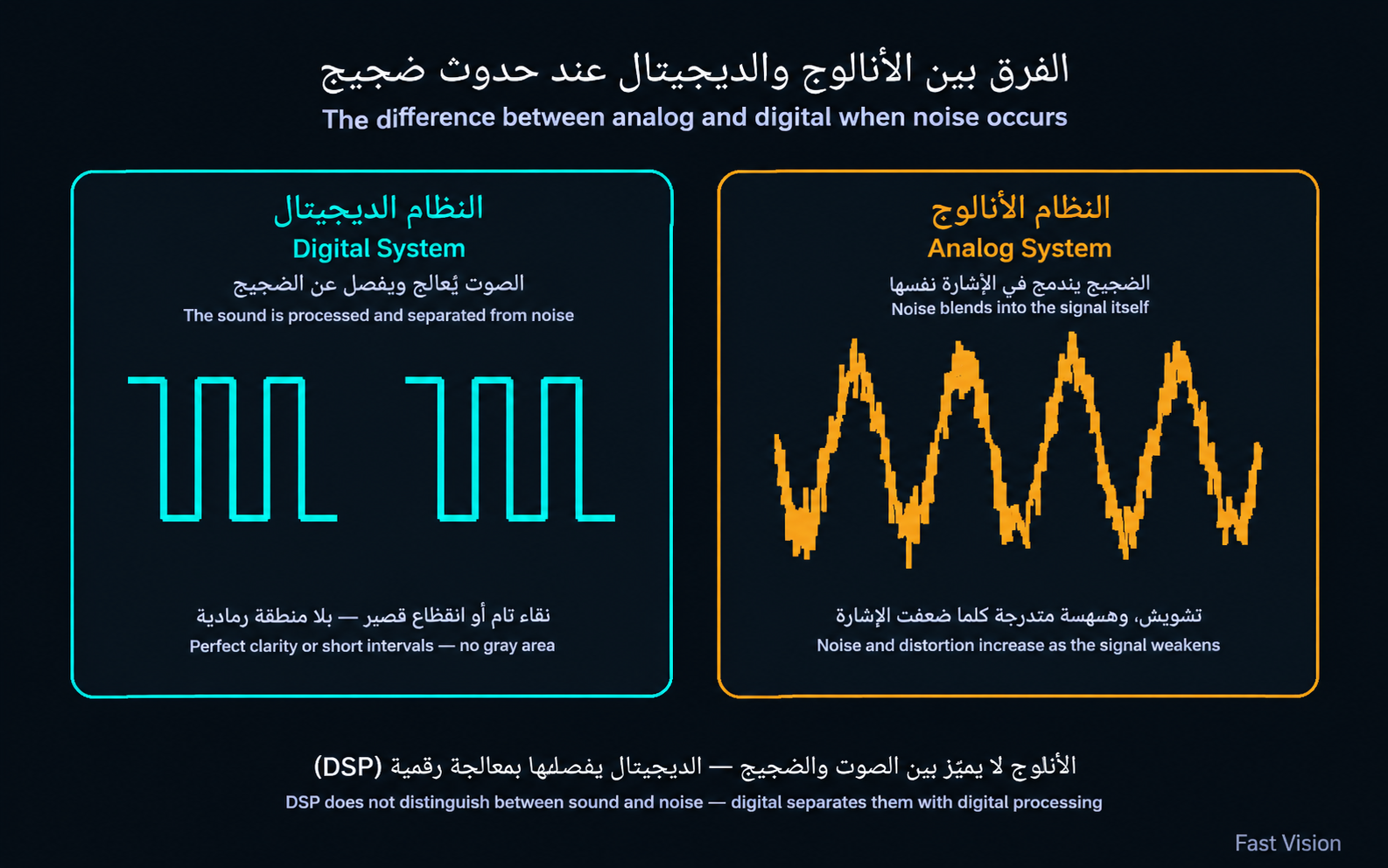
An analog system transmits the sound wave itself, carried on a continuous radio wave. The microphone converts air pressure into a varying electrical current, and that current is broadcast.The core limitation is structural, not a matter of build quality: a continuous wave carries no way to distinguish voice from noise. Any interference picked up along the path — engine noise, kitchen extraction, a nearby radio source, a poorly shielded cable — merges into the same wave and arrives at the ear as part of the signal. The system cannot separate it later, because it is no longer a separate thing.What an analog system can do is limited to fixed filters that attenuate whole frequency bands. The problem is that human speech occupies the same bands as engine noise, so every reduction in noise takes some speech intelligibility with it.Day to day this shows up as a constant background hiss, static that grows as the crew member moves away from the base, and audio that fades gradually rather than cutting cleanly.
How a digital system works
A digital system doesn't transmit the wave — it transmits a numerical description of it. Audio is sampled thousands of times per second, converted to data, and sent over a wireless protocol. The prevailing standard in these systems is DECT, which runs on a band reserved for communication services (1.9 GHz in the United States, with regional variation). Because the band is reserved, it neither interferes with nor is disrupted by the Wi-Fi and Bluetooth devices filling a modern restaurant.
That changes three things:
The transmission itself is clean. Digital packets carry error correction. Either the packet arrives intact and the audio is perfectly clear, or it doesn't and you get a dropout — there is no grey zone of hiss and static. Weak signal in a digital system sounds like a brief cut, not degraded audio.
Processing becomes possible. Once audio is data, a digital signal processor can work on it. This is where the features in modern spec sheets come from: acoustic echo cancellation, which stops the crew member's voice returning through the post speaker; adaptive noise reduction; and wideband HD audio, which restores the high and low frequencies older systems clipped — precisely the frequencies that distinguish similar-sounding consonants.
Full-duplex communication becomes practical, so both parties speak at once in a natural conversational flow instead of waiting for a turn.
Comparison
| Analog | Digital | |
| Transmission | Continuous radio wave | Data packets with error correction |
| Frequency band | Shared, exposed to interference | Reserved DECT band |
| Noise behaviour | Merges into the signal, inseparable | Handled separately from voice |
| At weak signal | Progressive static and hiss | Brief dropout, then clean audio |
| Audio processing | Fixed filters only | DSP: echo cancellation, noise reduction, wideband |
| Conversation | Typically half-duplex | Full duplex |
| Privacy | Broadcast can be intercepted | Encrypted |
The third generation: from filters to AI
Moving from analog to digital solved the transmission problem. It left a harder one: noise entering through the microphone itself — noise genuinely present in the air at the moment of capture. No transmission protocol fixes that, because here the noise is a real part of the recording.Conventional digital systems handle it with preset filters — day and night settings, manually adjustable noise reduction levels. They work well when conditions resemble what the system was tuned for, and fail when conditions change.In June 2026, HME launched ClearSoundX, an AI-powered audio feature available exclusively on the NEXEO | HDX platform. Unlike static filters, its AI engine continuously analyses the audio environment, distinguishes voice from noise, and adapts to the conditions of each individual location.The outcomes HME targets are operational rather than acoustic: fewer repeated orders, fewer miscommunications at the window, and lower cognitive load on crew during peak hours — the numbers that actually surface in speed-of-service reporting.The feature is available on the NEXEO and NEXEO Pro tiers of the NEXEO | HDX platform. Older HME systems and competing platforms do not carry it; each manufacturer has its own processing under its own name.
🎧 Hear the difference
Explanation only goes so far. The clip below plays the same exchange twice under the same noise conditions: once through an analog system, once through a digital one.
Analog
Digital
a direct comparison between an analog and a digital system in a drive-thru lane, at identical ambient noise levels.
Listen for three things in particular:
- The constant background layer — in the analog clip a steady hiss sits under the speech. In the digital clip the background disappears entirely between sentences.
- Word endings — trailing consonants are the first thing analog loses, and they are what separate two similarly named menu items.
- What happens when a loud sound passes — watch how noise swallows the speech in one clip and speech stays in front in the other.
What this means for your restaurant
These differences are not equally significant at every site. In our experience in the Saudi market, the gap widens specifically at:
- Restaurants on highways and ring roads — continuous traffic noise is the worst case for an analog system.
- Dual lanes — higher risk of interference and cross-talk, which encrypted digital transmission addresses.
- Arabic-language ordering — Arabic menu names rely on fine phonetic distinctions, and the high-frequency clipping in older systems erases exactly those distinctions.
Conversely: a quiet side street, a single lane and moderate traffic means a standard digital system is enough, and you may not see a difference that justifies a further upgrade. We don't sell what the site doesn't need.
FAQ
Can an analog system be upgraded to digital by changing headsets?No. The base station determines both transmission and processing, and headsets are designed to work with a base station from the same family. Replacing headsets alone changes nothing about audio quality.
Is ClearSoundX available on any HME system?No. It is exclusive to the NEXEO | HDX platform, specifically the NEXEO and NEXEO Pro tiers. Older HME systems do not support it.
Do other systems lack noise cancellation?Not at all. Competing platforms include digital noise reduction and acoustic echo cancellation. The difference is that conventional processing relies on preset configurations, while ClearSoundX uses an engine that adapts to the environment.
How long does a new drive-thru installation take?It depends on existing conduit and the ground loop sensor. On a prepared site, installation, calibration and training are typically completed in one working day. If the lane needs cutting for a loop sensor, add that to the schedule.
Do heat and dust affect performance?The outdoor components, yes — the speaker post and microphone are the exposed parts. Choosing a post with an appropriate ingress protection rating and servicing the microphone periodically maintains performance in Saudi conditions.
In short
Analog carries noise along with speech because it cannot tell them apart. Digital separates them, which makes cleaning the audio possible. And the AI in ClearSoundX makes that cleaning adapt to each site instead of relying on a fixed setting.Fast Vision supplies and installs drive-thru audio systems, outdoor displays and digital menu boards across Riyadh, Jeddah and all regions of the Kingdom — with audio calibration, loop sensor setup and crew training included in scope.