LCD Video Wall vs LED Display: Which One Fits Your Project?
Almost every project meeting starts with the same question: video wall or LED? The honest answer is that the question cannot be settled in the abstract. Both technologies are mature and both are installed in thousands of sites — they were simply built to solve different problems. The right choice depends on viewing distance, content type, operating hours, ambient light, and a five-year budget rather than an installation-day price.This guide sets out the differences as we see them on site, not as they appear in manufacturer brochures.
How each technology works
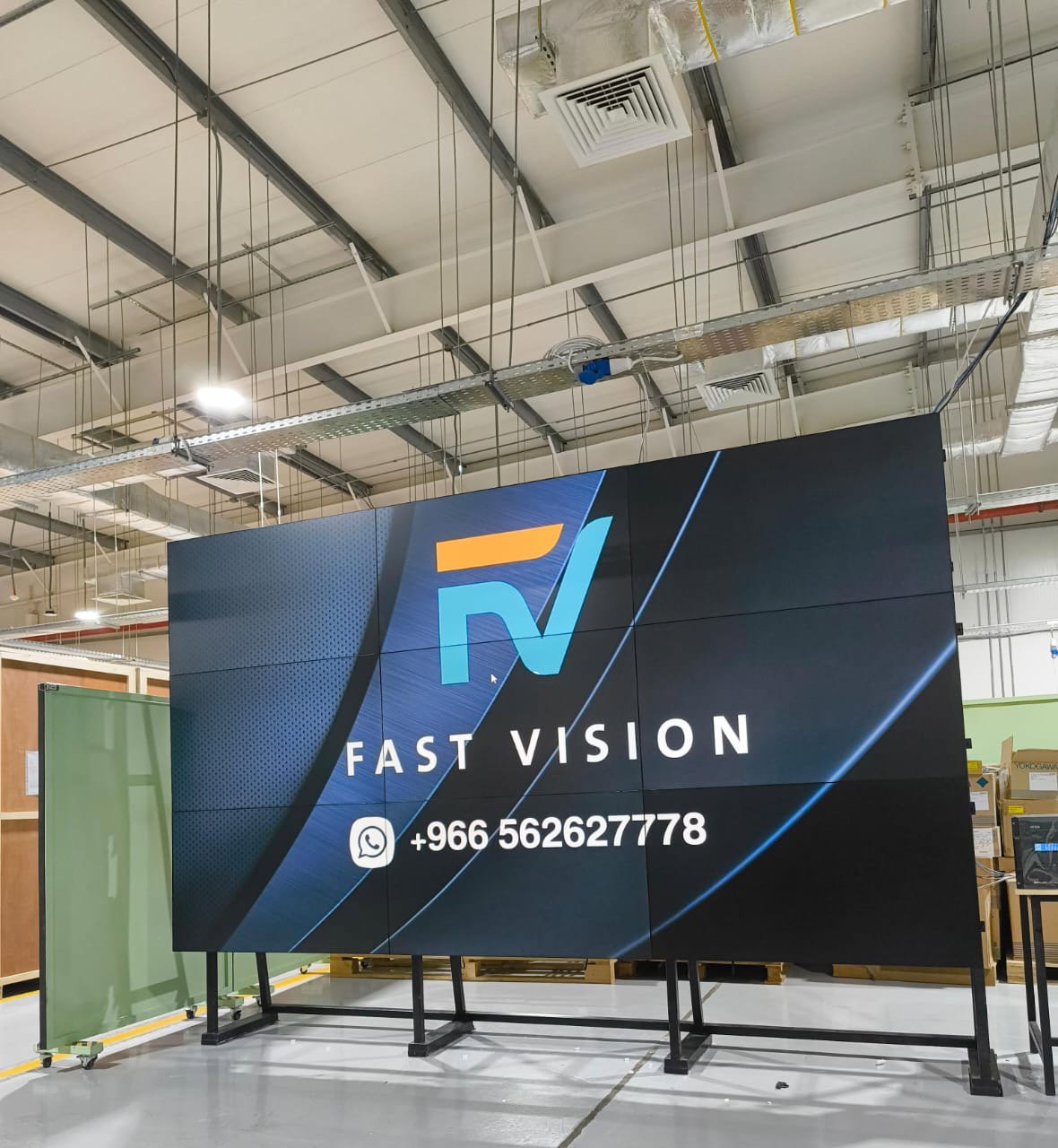
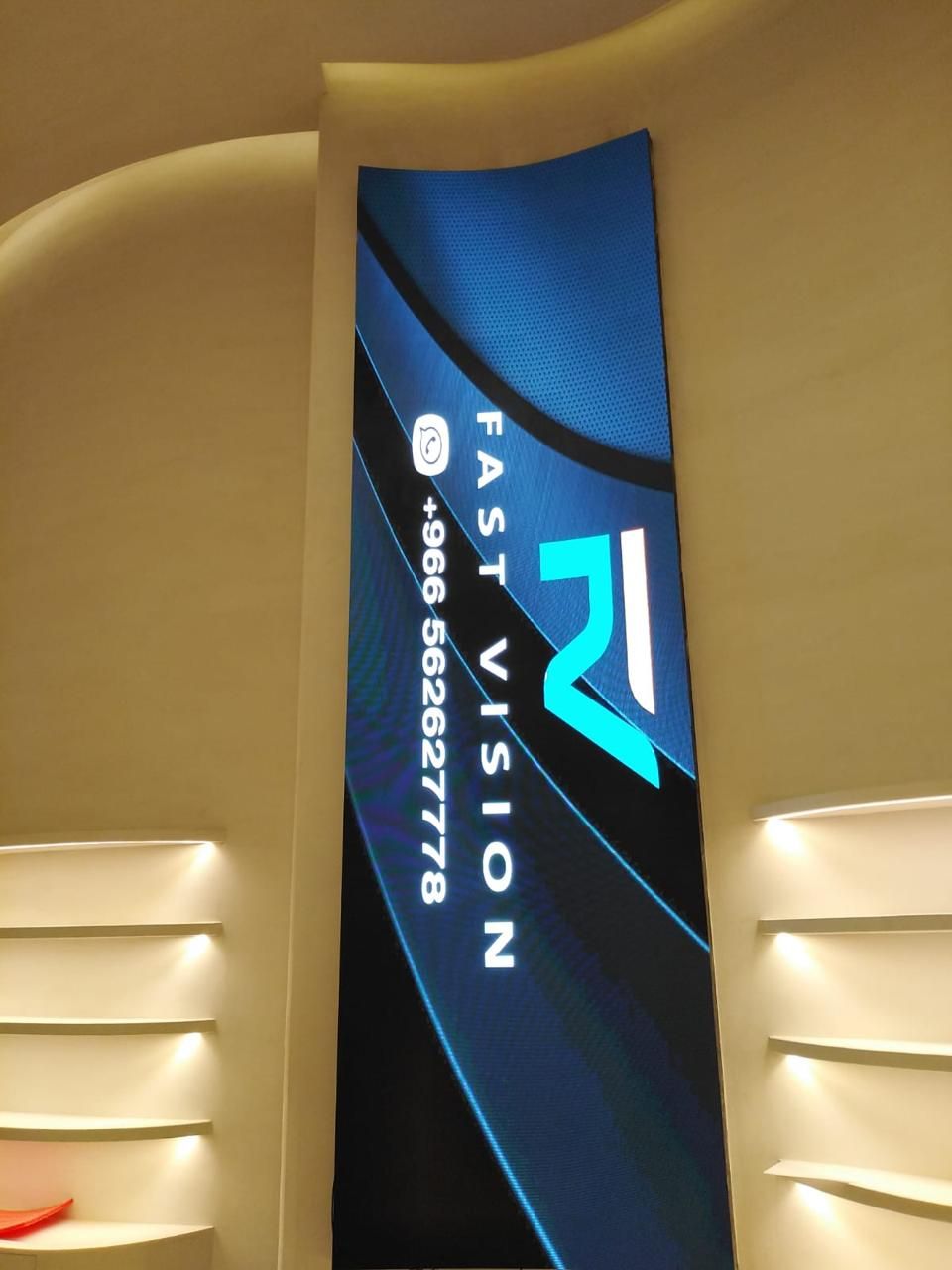
An LCD video wall is built from commercial-grade panels, usually 46" or 55", mounted in a 2×2, 3×3 or larger grid. Each panel is a liquid-crystal layer that emits no light of its own; an LED backlight sits behind it. That construction leaves a thin line — the bezel — between one panel and the next.An LED display is built from cabinets carrying modules of self-emitting LED packages. There is no bezel and no seam: the surface is continuous at any size, and it can be built in non-standard, curved or custom shapes.Every other difference follows from this one.
Bezel: the first thing a client notices
The narrowest commercial bezels today are around 0.44 mm panel-to-panel on premium series, rising to 1.7 mm and 3.5 mm on entry ranges. The line never disappears, though it becomes almost invisible on maps, dashboards and multi-window content.An LED display has no bezel at all. That is the main reason lobbies, showrooms and brand walls tend to go LED even at a higher cost: a logo with a black line through it loses its effect.Practical rule: if the content is one large brand image, the bezel is a problem. If the content is already divided into windows, cameras and tables, the bezel barely registers.
Brightness (nits)
- Indoor LCD video wall: typically 500–700 nits, ample for a light-controlled room.
- Indoor LED: typically 600–1,200 nits, dimmable to suit ambient light.
- Outdoor LED: from 4,500 up to 6,500 nits and beyond on the models we supply for façades and roadside sites.
- High-brightness outdoor LCD: around 3,500 nits with an IP rating, used for smaller façade and drive-thru positions.
The conclusion is firm: anywhere direct sunlight lands, or behind a glass façade, an indoor LCD video wall will look washed out regardless of panel quality. That is physics, not preference.
Viewing distance and resolution
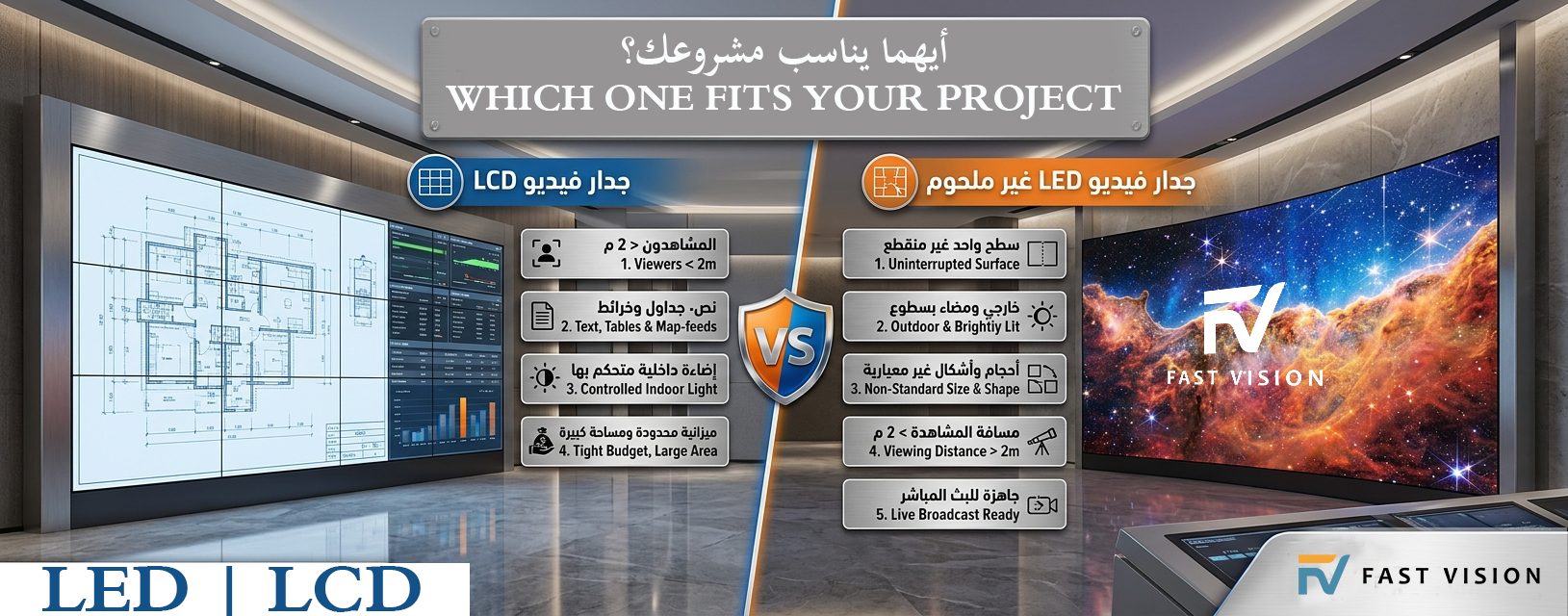
Here the ranking reverses in favour of LCD.A 55" Full HD panel has a pixel pitch of roughly 0.63 mm; at 4K it is about 0.315 mm. No commercially sensible LED display comes close — the finest indoor pitches we work with start at 1.2 and 1.5 mm.The accepted rule for LED: the shortest comfortable viewing distance in metres roughly equals the pixel pitch in millimetres, with a safety margin of up to 1.5×. A P1.5 wall resolves cleanly from about 1.5–2 m, a P2.5 wall from about 2.5–3 m.This is why control rooms — operators seated two metres from the wall reading small text and tables — remain strong territory for LCD video walls. As distance grows, that advantage fades and LED takes over.
Cost: look at five years, not at installation day
For a comparable area, an LCD video wall costs less to supply and install than a fine-pitch LED wall, and the gap widens as pixel pitch gets finer.But a real cost model includes items most comparisons skip:
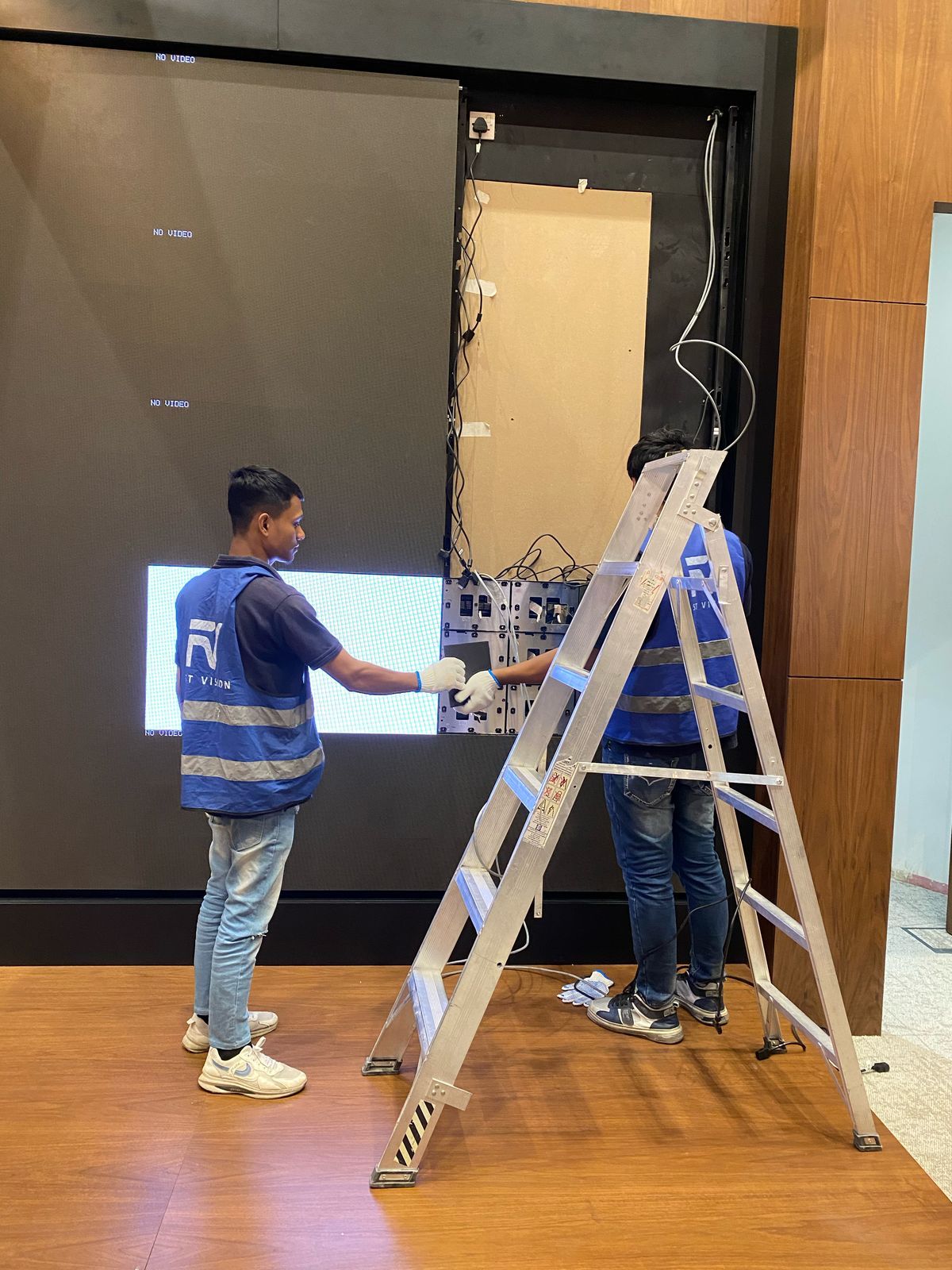
- Spare parts. On LED you replace one module cheaply. On LCD you replace an entire panel — and if the model is discontinued, colour mismatch with the aged panels can force a full wall replacement.
- Power. LED displays have a maximum and an average consumption figure; average on normal content is roughly one third of maximum. Do not size cooling and breakers from the maximum alone, and do not ignore it in the electrical design either.
- Ventilation. Both need a ventilation strategy; high-brightness LED in an enclosed space needs more attention.
- Structure. LED requires a steel frame levelled to the millimetre — a genuine line item, not an afterthought.
Lifespan and serviceability
Commercial LCD panels are typically rated 50,000–60,000 hours to half brightness; LED packages are usually rated at 100,000 hours. In practice the more important figure is not lifespan but repairability.On an LED wall, a fault is resolved at module, power-supply or receiving-card level, and front-service designs allow work without dismantling the wall or reserving rear access. On a video wall the replaceable unit is a whole display: heavier, costlier, and harder to colour-match against panels that have already run for thousands of hours.One further point: LED packaging has changed. Modern GOB and COB constructions are considerably more resistant to impact, moisture and abrasion than conventional SMD, which removes one of the oldest objections to LED in public circulation areas.
Quick comparison
| Criterion | LCD video wall | LED display |
|---|---|---|
| Seams between units | 0.44 – 3.5 mm line | None |
| Typical brightness | 500 – 700 nits indoor | 600 – 1,200 indoor · 4,500 – 6,500+ outdoor |
| Shortest comfortable viewing distance | Under 1 m | 1.2 – 3 m depending on pitch |
| Resolution in a small area | Excellent | Limited by pixel pitch |
| Outdoor use | Very limited | The right technology |
| Curved and custom shapes | Not practical | Supported |
| Replaceable unit on failure | Whole panel | Single module |
| Rated life | 50,000 – 60,000 hours | ~100,000 hours |
| 24/7 operation | Supported on commercial grades | Supported |
| Upfront cost for the same area | Lower | Higher, rising as pitch gets finer |
Choose an LCD video wall when
- Viewers sit or stand less than two metres from the screen.
- Content is text, tables, maps and camera feeds — already divided into windows.
- The space is indoor with controlled lighting: control room, operations centre, data centre, training room.
- Full 4K detail is needed across a relatively small area.
- The budget is tight and the required area is large.
Choose an LED display when
- The image must be one uninterrupted surface — brand wall, lobby, studio, stage.
- The location is outdoor, brightly lit, or behind glass.
- The size is non-standard: a long strip, a column, a curve, a ceiling, or a shape that follows the architecture.
- Viewing distance exceeds two metres.
- The screen will appear on camera or in a live broadcast (mind refresh rate and camera sync).
- Years of easy maintenance matter more than the initial price difference.
Scenarios from real projects
Security control room. Dozens of simultaneous camera feeds, operators two metres away. A commercial LCD video wall with a narrow bezel is the logical choice — unless the wall is very large and set back, where fine-pitch LED becomes a serious competitor.Corporate reception. Brand identity and promotional video, viewers passing at three metres. A P1.5 or P1.8 LED wall makes an impression a gridded wall cannot.Shop or building façade. No debate: outdoor LED at 5,000 nits or higher with an IP65/IP66 rating.Broadcast studio. Fine-pitch LED with a high refresh rate — the camera sees what the eye does not, and bezels are intrusive on shot.Meeting room. Short viewing distance and spreadsheet content favour a single interactive display or an LCD wall over a coarse-pitch LED.
FAQ
Is LED always better than a video wall?No. Under two metres with text-based content, an LCD video wall resolves detail better and costs less.Can both run around the clock?Yes, if you specify commercial grade. Consumer televisions are not built for it and their warranties do not cover it.How much rear space does an LED wall need?It depends on the service method. Rear service usually needs a walkway of at least 80 cm; front service allows near-flush wall mounting.Will colours drift between panels?On a video wall, drift appears as panels age and is managed by periodic calibration. On LED it is handled by factory point-level calibration, and cabinets should ideally come from one production batch.Which pixel pitch do I need?Take the shortest distance a viewer will stand at, in metres, treat it as the maximum pitch in millimetres, then step one grade finer if the content is text-heavy.
We help with the decision before the quotation
Fast Vision supplies and installs both technologies, so we have no interest in pushing you toward either. Send us the wall area, the closest viewing distance, the content type and the operating hours, and we will return a written two-option comparison and a scaled layout drawing before any pricing.
For More Details: